
Africa Should Grow From AI users To People Who Adapt and Build With AI For Our Local Solution

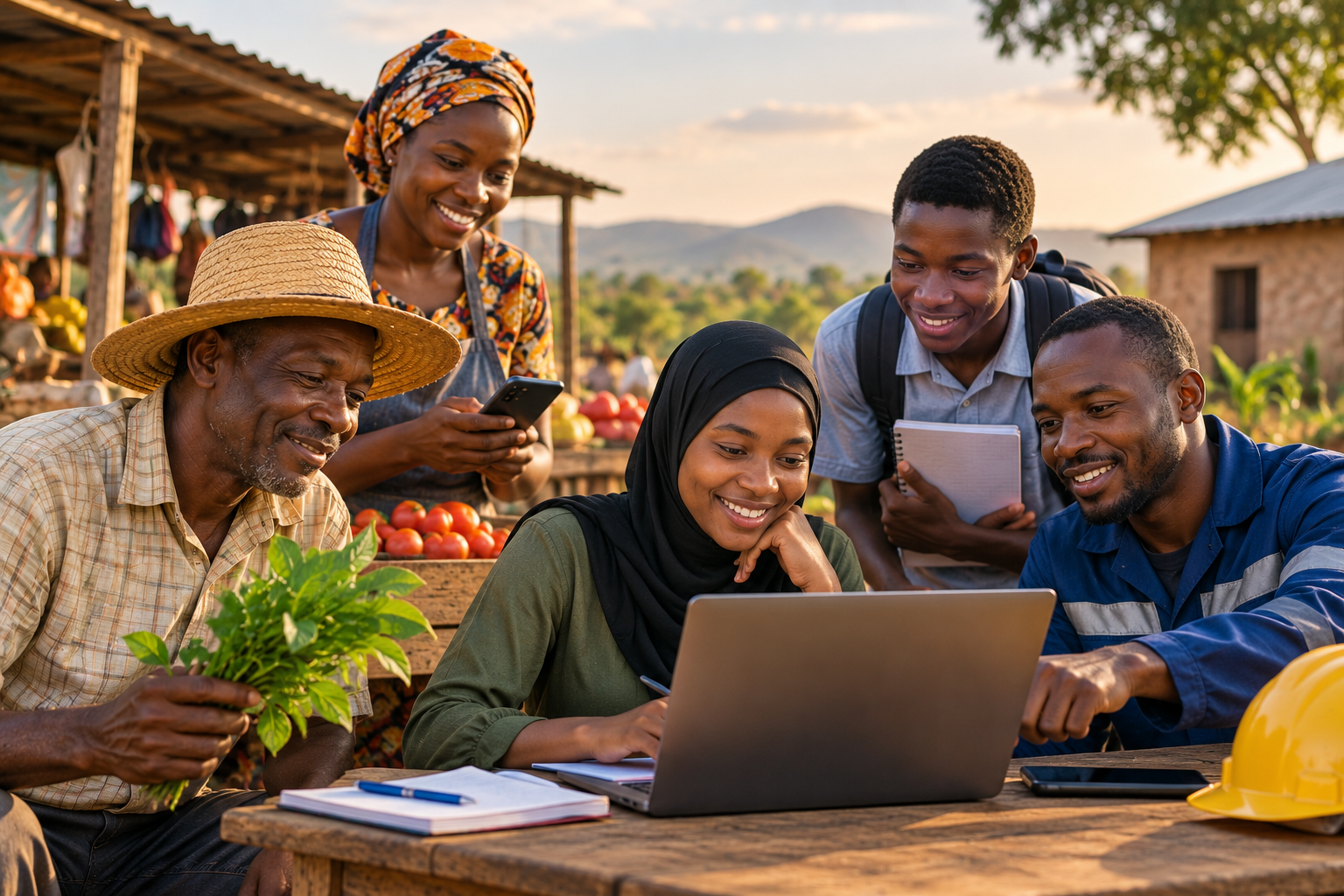
Artificial intelligence is no longer a tool for the developed countries neither does it only belong to the highly skilled technology professionals. But perhaps the more important question for Africa is much simpler: what can AI actually do for an ordinary African trying to farm, trade, study, work or build a business since its use is now liberalized and is now for every one?
The answer is becoming increasingly interesting. AI is moving from something we use to read about in the news to something that can become a practical assistant in everyday life. This is the reality of this technology that we can’t ignore! A farmer could use it to understand crop problems, interpret weather information or learn better farming practices. A trader could use it to create marketing content, organize products, communicate with customers and explore new markets. A student can use AI as a learning companion, asking questions repeatedly, requesting simpler explanations and practising difficult subjects without having to feel embarrassed about not understanding something the first time.
For workers, AI can help with many of the tasks that consume time every day, including writing reports, analyzing information, preparing presentations, organizing documents, translating content and researching problems. An engineer can use it as a research assistant, while a teacher can use it to prepare lessons and exercises. An entrepreneur who cannot afford a large team can use AI to help with market research, business planning, customer communication, marketing and even the early development of a digital product.
Now, coming back home, this is where AI could become particularly important for Africa. Many small businesses operate with limited capital and cannot employ a specialist for every function. AI does not remove the need for human expertise, but it can allow one person to accomplish more. A young entrepreneur with a good idea, for example, may now be able to research the market, develop a business plan, create a website, prepare marketing materials and test the idea before spending large amounts of money.
Agriculture provides another powerful example.
Recent initiatives are already looking at how AI can support millions of smallholder farmers with agricultural advice, climate information and access to useful knowledge. In September 2026, Google and the Gates Foundation announced an initiative aimed at bringing AI-powered agricultural, climate and language tools to 200 million smallholder farmers across Sub-Saharan Africa and South Asia. That matters because AI's value in Africa will not be measured only by how advanced the technology is, but by whether it can reach people whose daily lives and livelihoods depend on better information.
Language and accessibility will also be critical.
An AI system that works only for people who are comfortable typing sophisticated English into a computer will not reach the whole continent. Voice technology and African-language AI could make a significant difference, allowing people to interact with technology more naturally through speech. For someone in a remote community, the ability to ask a question and receive useful information through a phone could be far more important than having access to an expensive computer.
Of course, AI will not solve Africa's problems by itself. Reliable electricity, internet connectivity, affordable devices, digital skills and trustworthy information remain essential. There are also serious concerns around misinformation, privacy, fraud and people becoming too dependent on systems that can sometimes produce convincing but incorrect answers.
That is why Africa's opportunity should not simply be to become a continent of AI users. The bigger opportunity is to become a continent of people who understand, adapt and build with AI. African entrepreneurs can develop solutions for African markets, educators can experiment with new ways of teaching, engineers can apply AI to local infrastructure challenges, and young people can use the technology to create businesses and services that solve problems they understand personally.
The real question, therefore, is not whether AI will change Africa. It is already beginning to do so. The more important question is what Africans will do with it.
What happens when a farmer gains access to knowledge that was previously difficult to obtain? What happens when a student has a learning companion available at any time? What happens when a small trader can access capabilities that once required a marketing department? What happens when an entrepreneur can test an idea with a fraction of the resources previously required?
Perhaps Africa's AI opportunity is not simply about having the most powerful technology. It is about using available intelligence to increase what ordinary people are capable of doing.
The future may belong not only to those who build AI, but also to those who learn how to turn it into opportunity.
Engr. Yakubu Ishaku
Engr. Yakubu Ishaku is a Lead Technology Consultant, AI Specialist, and Digital Transformation Strategist. He combines engineering principles, artificial intelligence, and strategic vision to help organizations, government agencies, and digital practitioners achieve sustainable operational growth.
Comments
Loading comments...