
The Opportunity Our Forefathers Never Had: Africans Cannot Ignore This Digital Revolution!


The Opportunity Our Forefathers Never Had: Africans Cannot Ignore This Digital Revolution!
There is something extraordinary about the age in which we are living. For the first time in human history, an ordinary person sitting in a small room; with a smartphone, an internet connection, an idea and the willingness to learn, can potentially build and reach customers, employers, students, investors and audiences thousands of kilometres away. And now, Artificial Intelligence has added another powerful dimension to this transformation.
Think about that for a moment.
Our forefathers never had these opportunities.
Our grandparents did not have them either. Many of our parents entered adulthood without the internet, smartphones or the digital tools we now consider ordinary. Yet some of them still built businesses, acquired property, educated their children, became professionals, created institutions and left something behind. They did it with remarkably limited tools.
Imagine having a brilliant business idea in 1926. You could have the idea, the determination and even the product, but how would you tell 100,000 potential customers about it as quickly as today only using the internet? In those days they would have gone to the newspapers, radio, distributors, sales representatives, physical shops or simply word of mouth. This was a lot of work and resources!
In those days as a Teacher, if you wanted to teach people in another country, you must travel there. If you wanted to publish a book, you needed a publisher, a printing press and a distribution network. If you wanted to build a software company, you would first have to wait for the technology to exist. Today, those barriers have changed dramatically: Now Teachers can teach online from the comfort their rooms. Likewise, you can publish a book as an ePUB, eBook etc, offer professional services online, advertise to people around the world, create diverse digital products and build a software, all without first owning a large office or factor; just from the comfort of your home!
The Internet Changed the Marketplace. AI Is Changing What One Person Can Do.
The internet gave us access. AI is increasingly giving individuals leverage.
Before the internet, geography was one of the greatest limitations on opportunity. If you lived in a small town, your potential market was largely the people around you. The internet began breaking that wall. Today, your customer can live in Lagos, London, Nairobi, New York or somewhere you have never visited and you are in another location serving them.
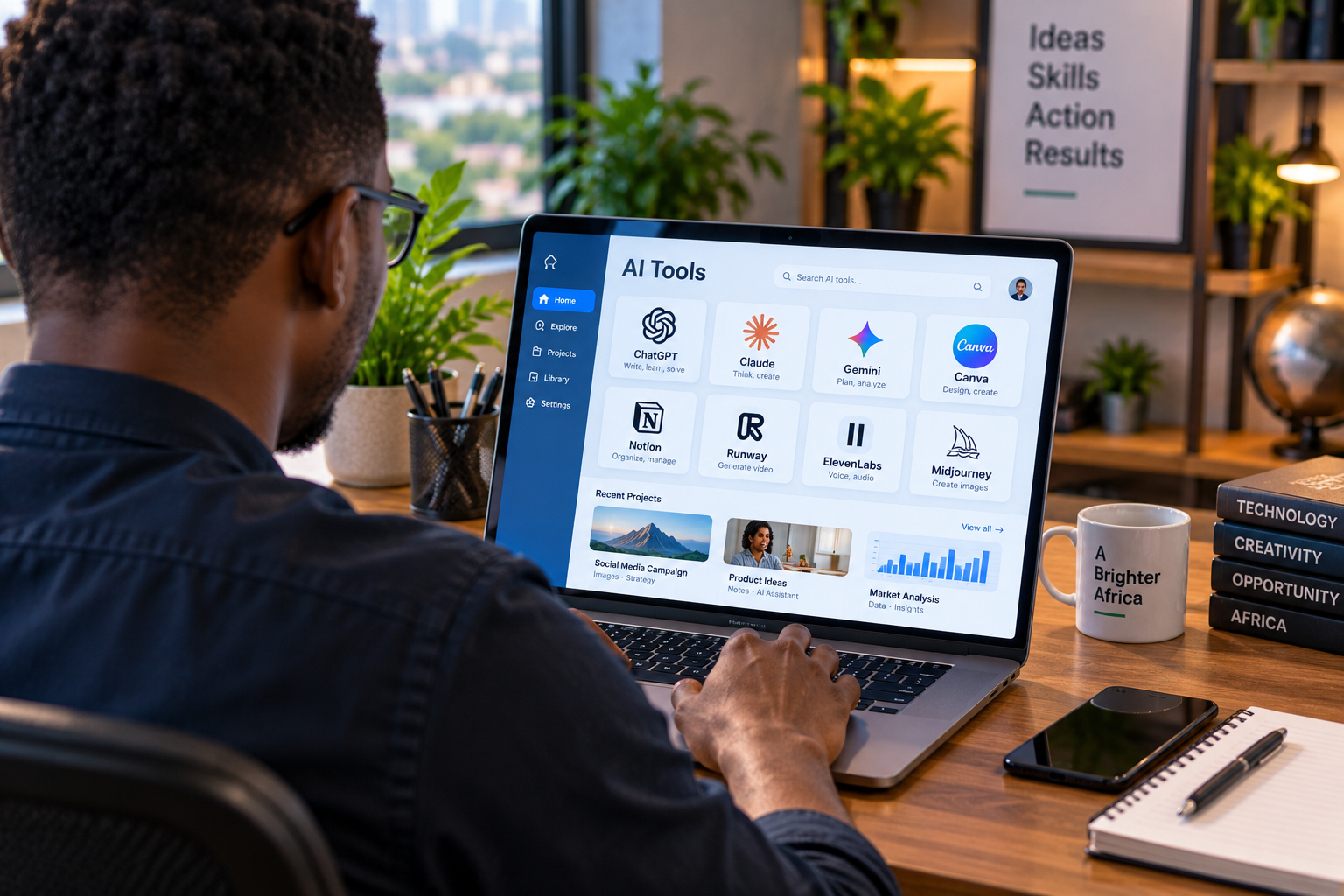
AI is taking this even further. It can assist with writing, research, programming, design, translation, data analysis, marketing, education, customer service and automation. It is not perfect, it does not eliminate the need for human judgement, and it certainly does not guarantee wealth. But it is changing what one determined person can accomplish.
That is where the real opportunity lies. The person who once needed five people to complete certain tasks may now be able to accomplish much of the work with a combination of technology, AI and his or her own expertise. This does not mean humans have become unnecessary. Quite the opposite. Human ideas, judgement, creativity, experience and problem-solving are becoming even more important because technology gives us more powerful ways to apply them.
But There Is a Problem Especially in Africa
As an African, I understand another side of this story. We have a serious trust problem when it comes to the internet.
For many people, the moment they hear the words “online opportunity,” or “Internet” or “Freelancing” suspicion immediately follows. And it is not difficult to understand why. Our societies have experienced online fraud, fake investment schemes, impersonation, fraudulent websites and people losing their hard-earned money to scams.
Over time, this has created what I called internetphobia; a fear or suspicion of anything that happens online. Someone hears about freelancing and thinks it is a scam. Someone hears about digital business and assumes it is fraudulent. Someone sees an online course and asks, “What are they trying to collect from me?” Someone hears that a person is making money through the internet and immediately concludes that something must be wrong.
We must be careful here.
Suspicion can protect us from fraud, but excessive suspicion can also prevent us from recognising legitimate opportunity.
The internet itself is not a fraud scheme. It is a tool. The same road can be used by an honest trader transporting goods and by a criminal committing a crime. We do not abandon these roads because criminals use them; we learn how to use them safely. A market is a place to buy and sell. Yet, some people use markets to sell fake products, cheat customers, or engage in fraud. We do not stop going to the market because of these criminals. We learn how to identify genuine products, deal with trusted sellers, and protect ourselves.
A school is a place to learn and develop knowledge and skills. Yet, even around schools, there can be dishonest people, fake certificates, fraudulent admissions, and other forms of deception. We do not abandon schools because some people misuse them. We learn how to recognize what is genuine and make informed choices. So why should the internet be different? The internet and AI are a tools; creating vast digital marketplace, classroom, workplace, and communication space. Yes, scammers and criminals operate online. But that does not make the internet a scam. It means we must learn how to use it safely.
We did not abandon the market because of fraud. We did not abandon schools because of dishonest people. We should not abandon the internet because criminals use it. We should learn how to navigate it, protect ourselves, and use its opportunities wisely.
We need digital literacy, not internetphobia. We need to learn how to verify businesses, recognise scams, protect our personal information, understand online payments and distinguish legitimate opportunities from fraudulent ones. The existence of fraud should make us wiser; not permanently afraid leaving us in backwardness.
We must not allow the existence of online fraud to blind us to the enormous amount of legitimate value being created by the world online every day.
Our Forefathers Did More With Less
This is perhaps the most humbling part of the conversation.
Many of the people who came before us walked long distances to conduct business. They farmed with basic tools, travelled for days, communicated through letters or messengers and built businesses without websites, social media or digital payment platforms. They had no Google to answer their questions, no YouTube to teach them and certainly no AI assistant to help them brainstorm an idea.
And yet, some succeeded. Their greatest advantage was not technology. It was initiative, discipline, courage and persistence.
Think about the significance of that.
A trader from an earlier generation might have had to physically travel from one community to another to find customers. A craftsman might have depended entirely on reputation and word of mouth. A teacher's knowledge might have reached only the students physically present in a classroom. Today, those same people who started in analogue or their descendants, can potentially take that knowledge far beyond their immediate surroundings due to the existence of the internet and the AI.
Your Knowledge May Be More Valuable Than You Think
One of the biggest mistakes African people are making is assuming they have nothing to offer online. Start with what you already know!
A teacher has knowledge. An engineer has knowledge. A farmer has knowledge. A mechanic has knowledge. A fashion designer has knowledge. A business owner has knowledge. A professional who has spent 20 years in an industry has experience that someone else may be willing to pay to learn. The digital economy gives us new ways to package and distribute that knowledge.
Knowledge can become a course. Experience can become consulting. A skill can become an online service. An idea can become a digital product. Content can build an audience, and an audience can eventually create business opportunities. AI can then help you research, organise, write, design, analyse, automate and communicate more efficiently.
You may already possess an asset you have never considered an asset.
The opportunity is therefore not necessarily to become a completely different person. It may simply be, to take what you already know and discover what technology can help you do with it. If you have a good idea, AI can help you develop it faster. If you have a skill, AI can help you package and market it better. If you have a business, AI can help you improve certain processes. But ultimately, someone still has to create something that another human being finds valuable.
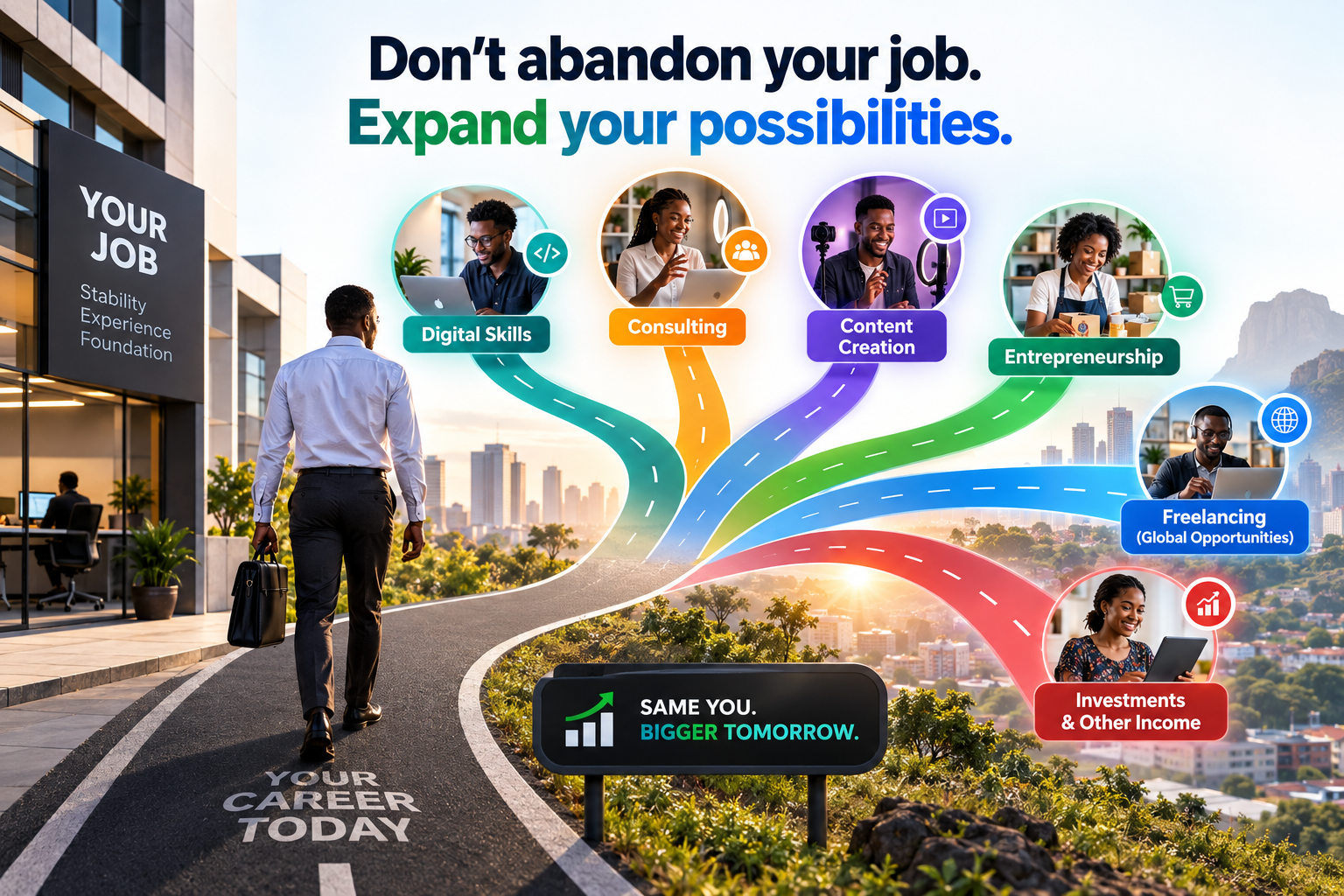
You Don't Have to Abandon Your Job
Having a traditional job is not the problem. Doctors are needed. Engineers are needed. Teachers are needed. Nurses are needed. Accountants, lawyers, technicians, builders and countless other professionals are needed. The problem is believing that your salary must be your only economic possibility.
Your job can remain your foundation while you build something else. You can learn a digital skill after work. You can explore AI. You can create content. You can offer a service online. You can build a small digital product. You can teach what you know. You can develop an audience. You can find ways to make your existing business more digital. You do not have to jump blindly from the old economy into the new one. Build the bridge while you are still standing on the old side.
This is particularly important because no job, however secure it may appear today, should be assumed to be completely insulated from technological and economic change.
The Greatest Risk May Be Refusing to Participate
I am not saying everyone who embraces AI will become wealthy. Nobody can honestly promise that. There will be failures, competition, bad ideas, failed businesses and technologies that disappear as quickly as they arrive. But there is another kind of risk we should discuss: the risk of doing nothing.
Imagine watching computers transform the workplace and refusing to learn them. Imagine watching the internet transform commerce and refusing to understand it. Imagine watching social media become a major communication channel and deciding that it has nothing to do with you. Imagine watching AI transform how people work while deciding that it is simply “for young people.”
Years later, the regret may not be that you tried and failed. It may be that you never tried at all.
And this is where I believe our generation needs to have an honest conversation. The future may not punish people simply because they chose traditional employment. But those who completely refuse to understand the technologies reshaping their industries, businesses and sources of income may eventually find themselves struggling to adapt. The world will continue changing whether we participate or not.
What Will We Tell the Next Generation?
Imagine your grandchildren asking you one day: “When the internet and AI were transforming the world, what did you do?”
What will your answer be? Will you say that you watched? That you were afraid? That you thought everything online was a scam? That you believed you were too old to learn? That you waited until everyone else had already figured it out? Or will you be able to say: “I saw the opportunity. I learned. I experimented. I failed a few times. I adapted. And I built something.” That is the answer worth working toward.
This Is Our Moment
Our forefathers built with the tools they had. Today, we have tools they could never have imagined. We can communicate across continents in seconds. We can learn from experts around the world. We can reach customers without owning a physical shop. We can create products without a factory. We can publish without a printing press. We can build businesses without first renting an office. And with AI, we can amplify many of our existing skills and ideas.
So, yes; keep your traditional jobs if they serves you. Build your career! Run your business. Raise your family. Do what you must do in addition, do not ignore the technological advancement of the internet and the AI! But do not close your mind to the digital economy. Learn it. Understand it. Use it wisely. Protect yourself from fraud. Experiment. Create. Build to conquer.
It is changing anyway.
Perhaps one of the greatest regrets of our generation will not be that we tried something and failed. It may be that we lived in an era our forefathers could only have dreamed about, possessed tools they could never have imagined, had ideas of our own; and still chose to remain spectators.
Don't let that be your story. Our forefathers built with less. We have more. Now it is our turn to build.
Engr. Yakubu Ishaku
Engr. Yakubu Ishaku is a Lead Technology Consultant, AI Specialist, and Digital Transformation Strategist. He combines engineering principles, artificial intelligence, and strategic vision to help organizations, government agencies, and digital practitioners achieve sustainable operational growth.
Comments
Loading comments...